UK Visa Refused: What Your Refusal Letter Means, How to Fix It & Reapply
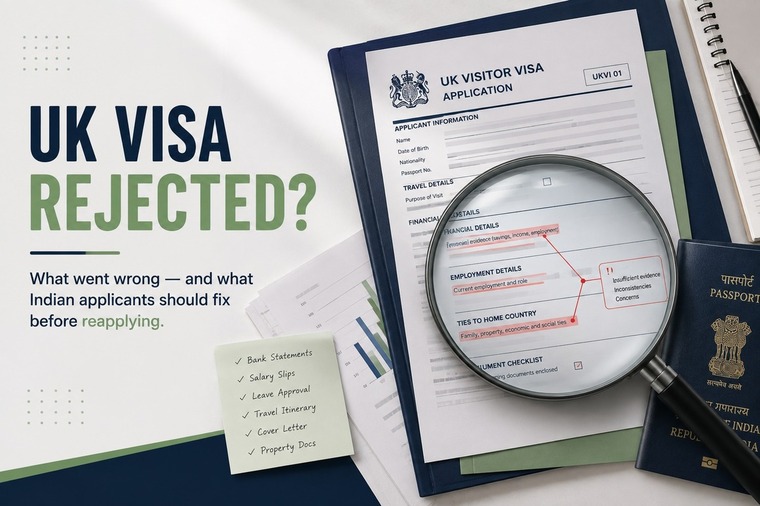
The One Rule That Drives Most Refusals
For Standard Visitor applications, many refusals are based on the genuine visitor requirements in paragraph V 4.2 of Appendix V to the Immigration Rules. Under V 4.2, the Entry Clearance Officer must be satisfied that you:
- Will leave the UK at the end of your visit
- Will not live in the UK through frequent or successive visits
- Are visiting for a permitted activity (tourism, family visit, business meeting, medical treatment)
- Have sufficient funds to cover the trip without working or claiming public funds
That's it. Four points. Every document in your file should reinforce at least one of these. When an application gets refused, it's because one or more of these wasn't backed up with convincing evidence.
The tricky part is that "genuineness" is subjective. Two applicants with nearly identical profiles can get different outcomes because one told a clearer, more documented story. The officer is looking for consistency — do your form, your documents, your cover letter, and your financial evidence all point to the same conclusion?
The 8 Reasons Indians Get Refused (and How to Fix Each)
Reason 1: Weak Ties to India
What the officer is thinking: "This applicant has no compelling reason to return home. They might overstay."
What the refusal letter says: "I am not satisfied that you will leave the UK at the end of your visit."
Why Indians get hit hard:
- Young, unmarried applicants without property or dependents
- Self-employed applicants with irregular income
- First-time travellers with no prior visa history
- Applicants visiting family members who have settled in the UK
How to fix it — Evidence Strength Matrix:
|
Weak |
Acceptable |
Strong |
|
Verbal claim of employment |
Employer letter without dates |
Employer letter with approved leave dates and confirmed return date |
|
No property in India |
Property tax receipt |
Registered sale deed in your name |
|
No dependents |
Marriage certificate |
Marriage certificate + children's school enrolment + spouse's employment letter |
|
Self-employed with no proof |
Business card or letterhead |
GST registration + 2 years ITR + active client contracts |
|
First-time traveller |
Passport with Nepal/Sri Lanka stamps |
Prior [Schengen](/schengen-visa), US, Canada, or Australia visa stamps |
There is no official minimum number of ties you must demonstrate. Strong applications typically include multiple independent factors — property, employment, family, business — each backed by a corresponding document.
Reason 2: Bank Statement Problems
What the officer is thinking: "The money in this account doesn't match the declared income. Where did it come from?"
What the refusal letter says: "I am not satisfied that you have adequate funds for your visit" or "funds from unknown sources."
Why Indians get hit hard:
- Large deposits appearing suddenly (gift from parents, property sale, FD maturity)
- Salary credits don't match the employer declared on the form
- Fixed deposit broken just before application
- Only savings account shown, not salary account
- Balance dips in the period before application
How to fix it — Evidence Strength Matrix:
|
Weak |
Acceptable |
Strong |
|
Bank statement only |
Bank statement + salary slips |
Bank statement + salary slips + Form 16 + employer letter confirming CTC |
|
Unexplained large deposit |
Gift deed from family member |
Gift deed + donor's bank statement + relationship proof + bank transfer trail |
|
FD broken before application |
FD maturity certificate |
FD maturity certificate + reinvestment proof showing the money stayed in your accounts |
|
Single savings account |
Salary + savings accounts |
Salary + savings + fixed deposits — all showing consistent income pattern |
|
₹1L balance for ₹3L trip |
₹3L balance matching trip cost |
₹4-6L sustained for 3+ months with documented income sources |
The classic red flag: A ₹3–4 lakh credit appearing ten days before you apply, with no explanation. The officer's first assumption is that it's borrowed money staged to meet requirements. If the money genuinely came from an FD maturity, a property sale, or a family gift — document it with source certificates before you apply, not after.
Reason 3: Inconsistencies Across Documents
What the officer is thinking: "The form says one thing, the documents say another. Something doesn't add up."
What the refusal letter says: "The documents provided are inconsistent" or "I am not satisfied that you are a genuine visitor."
Common inconsistencies Indians make:
- Income on the application form doesn't match ITRs or salary slips
- Employment dates don't match between the employer letter and the form
- A sponsor's letter contradicts your stated travel plans
- The cover letter mentions business activities but you've applied as a tourist
- Bank statement salary credits show a different company name than your employer
The Cross-Check Rule — Before submitting, verify these 5 things match EXACTLY across all documents:
|
Check |
What to verify |
|
✅ Name spelling |
Same across passport, form, bank statements, employer letter |
|
✅ Employment details |
Same designation, same company, same dates |
|
✅ Travel dates |
Same on form, flight booking, hotel booking, cover letter |
|
✅ Financial figures |
Same balance on form as on bank statement date |
|
✅ Address |
Same on form as on utility bill / bank statement |
If there's a discrepancy — for example, salary processed through a payroll company — explain it proactively in your cover letter or employer letter. Don't wait for the officer to wonder.
Reason 4: Missing or Weak Documents
What the officer is thinking: "The applicant hasn't provided enough evidence to assess their application."
What the refusal letter says: "Insufficient documentation" or "I was not provided with..."
The most common missing-document mistakes are submitting only the passport bio page instead of all pages, a bank statement covering too short a period, an outdated ITR, and a generic employer letter without dates. The cover letter deserves special attention — it's your one chance to speak directly to the caseworker.
What Your Refusal Letter Actually Says
Your refusal letter is written in formal language, but it's telling you exactly what went wrong. Here's how to decode it — and what to do about each one:
|
Refusal Letter Phrase |
What It Actually Means |
Reason # |
How to Fix |
|
"I am not satisfied you will leave the UK" |
Weak ties to India |
#1 |
Add property, dependents, employment proof — three independent ties minimum |
|
"I am not satisfied you have adequate funds" |
Financial evidence doesn't match declared income |
#2 |
Reconcile all numbers, add source documentation for any large credits |
|
"Funds from unknown sources" |
Unexplained deposits in bank statement |
#2 |
Gift deed + donor's bank statement + relationship proof |
|
"The documents provided are inconsistent" |
Something doesn't match across documents |
#3 |
Reconcile every detail before reapplying |
|
"I was not provided with..." |
Missing document |
#4 |
Simply provide the missing document |
|
"I am not satisfied you are a genuine visitor" |
Overall doubt — combination of weak factors |
#1–4 |
Address ALL concerns from the letter |
|
"Purpose of visit not consistent" |
Documents don't match stated purpose |
#5 |
Declare the actual purpose accurately |
|
References to Paragraph 9.7 or SUI 9.1 |
Deception may be alleged — seek qualified legal advice |
#6 |
Consult an immigration lawyer immediately — serious consequences possible |
What the refusal letter also tells you: For Standard Visitor Visa refusals from India, there is no right of appeal. Administrative review is available only in limited cases where you believe the caseworker made a factual or legal error — not if you simply disagree with the decision.
Reason 5: Failing the Genuine Visitor Test (Catch-All)
This is the broadest refusal ground. When the officer can't pinpoint one specific problem, they cite the genuine visitor requirement as a whole. It usually means multiple weak factors combined — weak ties, modest finances, vague purpose, no travel history.
What makes this tricky: The refusal letter often lists several concerns together rather than naming one clear issue. Your reapplication needs to address all of them, not just one.
How to fix it: Think of your application as a story. Every document should tell the same story: "I have a specific reason to visit, I can afford it, I have strong reasons to return, and I've been honest about everything." If any document contradicts that story, fix it.
Reason 6: Misrepresentation or Deception
This is the most serious ground for refusal.
A finding of deception means the officer has determined that you provided false information or documents, or made material representations that were untrue. The consequences can be severe:
- Mandatory refusal
- A refusal period of up to 10 years in relevant circumstances
- The finding may be cross-referenced with other countries' visa databases
What may be treated as deception:
- False employer letter (overstated salary or designation)
- Fabricated bank statements
- Fake property documents
- Agent-supplied documents that turn out to be false
- Failure to disclose a previous visa refusal when asked on the application form
The last point catches many applicants. The UK visa form asks: "Have you ever been refused a visa or entry by any country?" Failing to disclose a previous refusal — whether from a Schengen country, the US, Canada, Australia, or elsewhere — may lead the Home Office to question your honesty. However, a previous refusal alone does not automatically result in a deception finding. Deception is a legal determination made by the caseworker based on the specific circumstances.
What to do instead: Always declare previous refusals honestly. In your cover letter, briefly explain the context — what happened, what's changed since then, and why your current application is stronger. If you receive a refusal letter that alleges deception, seek qualified immigration advice before reapplying.
Reason 7: Poor or Missing Cover Letter
The cover letter is where most applicants either save themselves or sink themselves. A weak cover letter doesn't cause refusal on its own — but it fails to rescue an application that has other gaps.
What a weak cover letter looks like:
- Generic template copied from the internet
- No specific details about the trip
- No explanation of ties to India
- No mention of how the trip is funded
What a strong cover letter includes:
- Specific purpose: "I am visiting my brother Rahul in London for his wedding on [date]"
- Ties to India: "I own a residential property (registration attached) and my business GST filings show ₹X revenue"
- Financial plan: "The trip will cost approximately ₹X, funded from my savings account (statement attached)"
- Travel history: "I have previously visited Dubai (2023) and Thailand (2024) and returned on time"
- Return proof: "My return flight is booked for [date] and I have to report to work on [date]"
The cover letter should be one page, factual, and specific. It should not repeat what's in the documents — it should connect the dots between them.
Reason 8: Timing Issues
Applying too close to your travel date creates practical problems, not just perception issues. If your application is refused and you need to reapply, you need buffer time — and applying late removes that option. Avoid booking non-refundable flights or hotels before you have a decision.
How to Reapply: Step-by-Step
There is no mandatory waiting period — you can technically reapply immediately. However, reapplying with substantially the same evidence without addressing the refusal reasons is unlikely to improve the outcome. For examples of successful reapplications, see our [UK visa refusal success stories](/case_studies/uk-visa-refusal-success-story).
Step 1: Read the refusal letter carefully.
The specific ground for refusal is stated. Highlight every concern. This is the exact issue your next application must address.
Step 2: Declare the previous refusal.
The new application form asks about previous refusals. Declare it. The Home Office already has the record. Failing to declare it triggers the deception ground — which is worse than the original refusal.
Step 3: Fix the specific issue cited.
Don't try to fix everything — fix what the letter says.
|
If the refusal cited... |
Then... |
|
Weak ties |
Add property documents, family certificates, stronger employer letter |
|
Insufficient financial evidence |
Add bank statements covering a sufficient period to demonstrate income patterns, plus source documents for any large credits |
|
Inconsistent documents |
Reconcile every number across every document |
|
Missing document |
Simply provide the document |
|
Deception |
Seek qualified immigration advice before reapplying — serious consequences possible |
Step 4: Write a fresh cover letter.
Address each refusal point directly. "In my previous application, I was refused because [reason]. I have now provided [evidence] to address this concern." Keep it one page, factual, and specific.
Step 5: Submit early.
Apply at least 6–8 weeks before your intended travel date.
Quick Reference
|
Detail |
Value |
|
Refusal rate (Indians, visitor visa) |
~9% (some reports say up to 18% in 2026) |
|
Fee lost on refusal |
£127 (~₹16,500) — non-refundable |
|
Most cited refusal ground |
Paragraph V 4.2 — genuine visitor test |
FAQs
- What is the UK visa rejection rate for Indians?
Approximately 9% of Indian Standard Visitor Visa applications are refused, based on Home Office data and industry reports. Some reports suggest the rate may have climbed to around 18% in 2026 due to tighter scrutiny on financial documents and ties to India.
- Does a UK visa refusal affect future applications?
Yes — you must declare it in all future UK visa applications, including any refusal from a Schengen country, the US, Canada, or Australia. A refusal alone is not a bar to future approval, but concealing it is treated as deception, which can result in a 10-year ban.
- What if my refusal letter mentions deception?
Seek qualified immigration advice before reapplying. A deception finding is the most serious ground for refusal and can carry a refusal period of up to 10 years in relevant circumstances. Do not reapply on your own until you understand the finding and how to address it.
- How long does a UK visa refusal stay on my record?
There is no fixed expiry for a refusal record — it stays on your UKVI file and must be declared in every future UK application. A refusal does not automatically bar you from future approval, but each new application is assessed on its own merits with the previous refusal taken into account.
- Will a UK refusal affect my Schengen, US, Canada, or Australia visa?
Not automatically. Each country assesses applications independently. However, many visa systems ask whether you have ever been refused a visa by another country, and a UK refusal may be considered as part of your overall travel history. Always answer honestly — concealing a refusal can be treated as deception.
- What is the difference between a refusal and a rejection?
In practice the terms are used interchangeably for UK visitor visas. A refusal is a formal decision that you do not meet the visa requirements, and it comes with a refusal letter explaining the grounds. There is no separate "rejection" category for Standard Visitor applications from India.
Need Visa Assistance?
Get your UK visa approved FASTER with our expert team!
Our UK visa specialists can review your refusal letter, tell you exactly what went wrong, and help you build a stronger reapplication.
TALK TO OUR VISA EXPERTS NOW Pune: +91 020 49027000 | Dadar: +91 022 45830600 | Thane: +91 022 69814000